
Verifiable execution layer
Turn AI and cloud trust claims into proof your customers can verify.
Veritas helps teams prove how sensitive workloads were governed, approved, executed and verified so enterprise buyers do not have to rely only on logs, screenshots, questionnaires or post-hoc audit narratives.
Built for AI and cloud platforms handling sensitive customer data. Veritas helps teams prove governed execution when enterprise review, regulated approval, customer trust friction or confidential autonomous workflows make ordinary observability insufficient or unsafe to expose.
Veritas platform overview
Cryptographic trust for AI and cloud workflows.
It is designed for high-assurance AI and cloud workflows where sensitive data, customer approval, runtime integrity and confidentiality all have to be proven without exposing the very details the trust model is meant to protect.
This overview shows how Veritas connects the people, policies, runtime checks, approval points and evidence artifacts needed to prove sensitive execution.
Hover or focus any persona, capability, workflow step, input, output, approval control or business outcome to explore how trust conditions become proof.
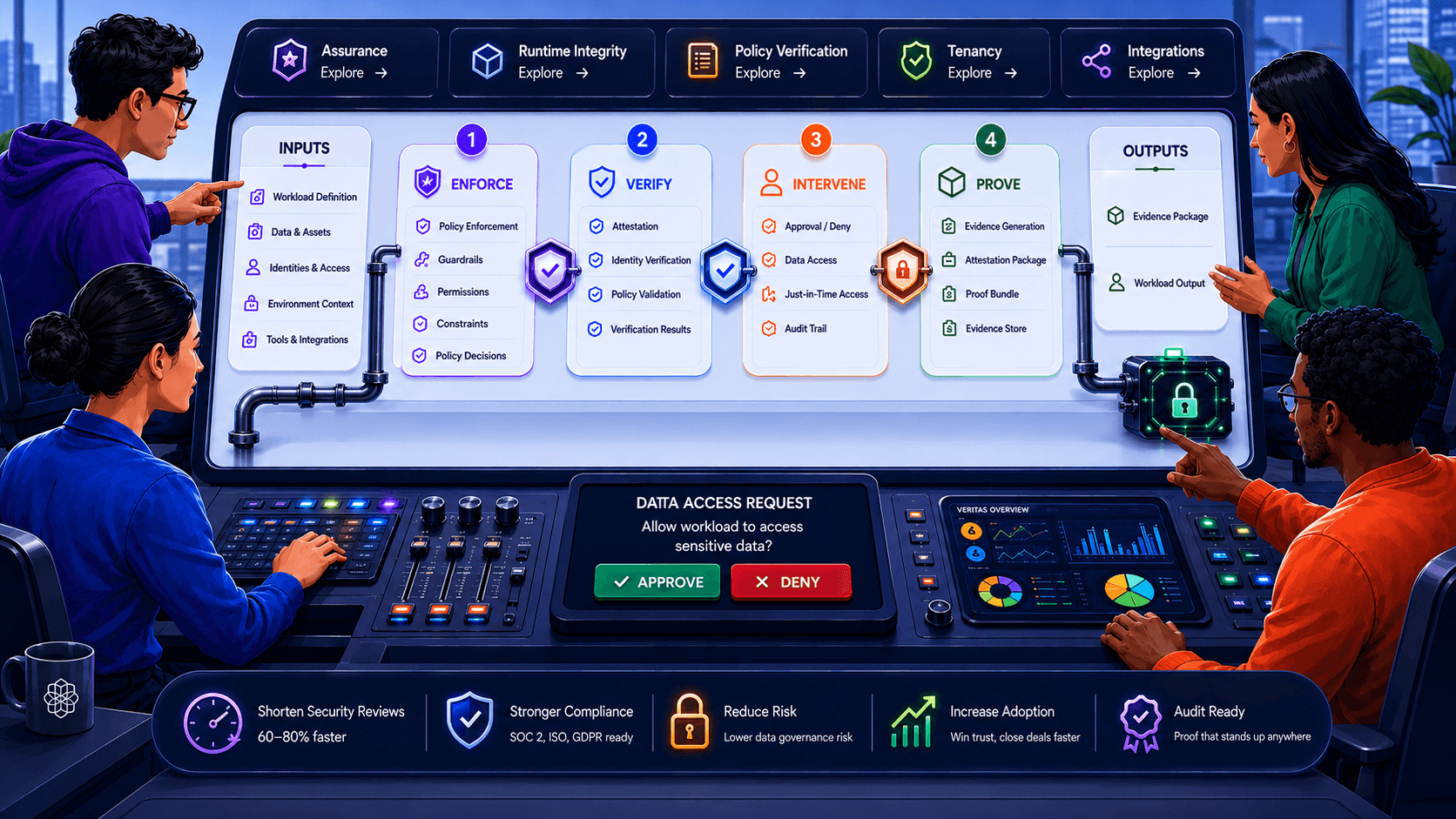
Tap a persona, capability, workflow step, input, output, approval control or outcome to explore the Veritas trust model.
Runtime enforcement
Policy decision + execution result
Confidential runtime
Attestation + runtime identity
Approval checkpoints
Approver, reason, and decision state
Evidence artifacts
Receipt, verification result, and proof bundle
Customer verification
Reviewable report tied to the execution
From claims to proof
Modern AI and cloud-native systems increasingly ask customers to share sensitive data, approve automated decisions and trust distributed execution. Most platforms still explain that trust with logs, screenshots and post-hoc audits. That is not enough when customers want to know how their data was actually used.
Veritas adds the missing verification layer: trust policies are enforced, trust conditions are verified at execution, human approval can intervene and runtime evidence is generated for customer verification.
Claim-based review
Policies
Described in documents
Logs
Explain activity after the fact
Screenshots
Point-in-time evidence
Questionnaires
Require interpretation
Proof-based review
Policy
Checked at execution
Runtime
Attested and verified
Approval
Captured with actor + decision
Evidence
Portable proof bundle
assertion.swname
== "CONFIDENTIAL_SPACE"
Trust policies can be checked at execution, including workload identity, runtime integrity, environment placement, approval state and data-use constraints.
That gives your customers more than a narrative: it gives them evidence that data was used under the agreed conditions.
Veritas enables
Before data use
Define the trust conditions for data use: who is acting, what is running, where it runs, which policy applies and whether approval is required.
During execution
Enforce multi-party trust policy at execution and pause for human approval or operator intervention when conditions require it.
After execution
Generate runtime evidence your customers, auditors and regulators can independently verify.
How policy becomes proof
Trust policy checks
assertion.swname == "CONFIDENTIAL_SPACE"
"STABLE" in assertion.submods.confidential_space.support_attributes
assertion.submods.gce.zone == "us-central1-a"
size(assertion.submods.container.env_override) == 0
assertion.hwmodel == "GCP_AMD_SEV"
Runtime evidence
Confidential Space image
Matched
Support attribute
STABLE
Workload zone
us-central1-a
Container overrides
None detected
Confidential hardware
GCP_AMD_SEV
Outcome
Trust conditions matched: data use approved and evidence generated.
Strategic shift
Observability → Attestation
Observability explains system activity. Veritas helps your customers verify that data was used under the right conditions.
Trust → Verification
Customers do not have to rely only on claims. They can inspect runtime evidence generated when execution occurred.
Cost-center → Revenue-generator
Trust becomes easier to evaluate, helping security reviews, procurement and sensitive customer adoption move with less friction.
Trust conditions Veritas can verify
Verify Confidential Space image type and support attributes.
Validate image digest, signatures and runtime configuration.
Detect env and command overrides before execution.
Verify service accounts and workload identity.
Restrict zone, project and instance configuration.
Confirm confidential compute platform (AMD SEV / TDX).
Proof over promises
Your customers can’t verify trust from claims alone.
Today, trust is still built from documents, dashboards, and explanations. Veritas helps your platform turn agreed data-use conditions into runtime evidence customers can verify. That matters most in high-assurance workflows, where standard observability can expose more than the trust model allows.
OLD MODEL
Requires interpretation and trust
VERITAS
Runtime verification layer
OUTCOME
Evidence buyers can evaluate
Digital transformation should not force customers to choose between innovation, privacy and control.
Veritas helps your platform make data use enforceable at execution and verifiable afterward.
Use cases
Where proof changes the customer conversation.
Veritas is strongest when a customer, auditor, or data owner needs more than a control narrative. Each use case connects a real buyer concern to the runtime conditions that can be enforced, verified, and turned into evidence.
Enterprise security reviews
Give customer security teams evidence they can inspect instead of only questionnaires, screenshots or control narratives.
Buyer question
Can you prove our data only ran under the approved identity, runtime and boundary?
Sensitive AI workflows
Support AI workflows where customers need confidence before sharing regulated, financial, identity, health or confidential data.
Buyer question
What lets us share sensitive data with this workflow without relying only on assurances?
Data sovereignty and external data boundaries
Show that sensitive processing happened in an approved project, zone, runtime and policy boundary before data is released.
Buyer question
Can you prove our data stayed within the approved trust boundary before release?
Human-approved execution
Require a data owner, operator or authorized reviewer to approve a sensitive action before execution or release continues.
Buyer question
Can this action be stopped until the right person explicitly approves it?
Trust fit
Get the right trust configuration without guessing.
Use Trust Fit to turn a customer trust concern into a practical pilot path: define the workload, identify the proof audience, choose the right runtime model, capture approval requirements, and clarify what evidence the buyer needs before they can move forward.
Configuration effort map
Example Trust Fit output
A Trust Fit result helps translate the buyer concern into a practical runtime model, approval requirement, and evidence path.
Recommended default
MediumTenant-dedicated governed session
Best balance for enterprise buyers who need stronger proof without per-job orchestration.
Fastest pilot
LowShared Veritas-managed runtime
Best for proving the business value quickly with lower-sensitivity design-partner workloads.
Highest assurance
HighPer-execution ephemeral runtime
Best when each governed execution needs its own short-lived runtime and evidence path.
Strongest data-owner control
HighCustomer-held key / external data boundary
Best when the customer or data owner must control release outside the Veritas boundary.
How it works
How Veritas turns governed execution into proof.
First define the trust conditions. Then run the workload under those conditions. Finally, deliver the workload output together with evidence a customer or auditor can verify.
1. Define trust conditions
Tenant profile, workload identity, policy requirements and approval expectations.
2. Govern execution
Enforce, verify and intervene while the workload runs under the agreed conditions.
3. Deliver proof
Return the workload output with evidence, verification result and proof bundle.
Verifiable Execution moves from policy to proof.
Veritas makes the trust sequence visible: define the policy, verify runtime conditions, pause for people when needed and produce Evidence the customer can inspect.
Package
01
Enforce
Enforce multi-party trust policy
Define how data can be used, who can act, which workload is allowed and when Approval is required.
Policy constraints are established before Verifiable Execution begins.
02
Verify
Verify trust conditions at execution
Check identity, runtime, environment, policy and Approval requirements before sensitive data is used.
Runtime conditions are checked where risk actually happens.
03
Intervene
Intervene through Approval
Pause or continue execution when a data owner, Operator or authorized reviewer must approve a sensitive action.
Human judgment becomes an explicit checkpoint, not an afterthought.
04
Prove
Prove execution with Evidence
Generate Evidence at execution that shows what ran, where it ran, which conditions were met and how data was handled.
Evidence becomes something your customer can inspect and verify.
How the verification layer works
Your platform enforces multi-party trust policy, verifies trust conditions at execution, supports Approval when needed and produces Evidence your customers can independently verify.
Business requirement
Why verification is becoming a business requirement.
Across security, compliance, AI adoption and procurement, buyers increasingly expect evidence they can evaluate to verify the assurances they are being asked to trust.
Review friction
21 days
lost to manual evidence gathering
Across security review and procurement, teams lose time translating controls into proof buyers can actually evaluate.
Questionnaire
6 days
Evidence
5 days
Clarify
4 days
Re-review
6 days
Source: Veritas modelled buyer-review workflow
AI governance
38%
concern level in the latest period
Governance pressure is becoming a buying condition as AI systems move closer to sensitive customer workflows.
2023
2024
2025
Source: Deloitte cited planning stat
Third-party risk
30%
involvement in the latest period
As more value chains depend on vendors and cloud services, trust increasingly needs to travel across organizational boundaries.
2023
2025
Source: Verizon DBIR cited planning stat
Veritas sits inside the trust boundary
Veritas connects operators, workload authors, data collaborators, auditors, cloud services, tenant environments and enterprise trust consumers.
The point is not another dashboard. The point is governed execution that turns runtime policy, confidential execution and Attestation into Evidence another party can verify before they approve, buy, audit or expand usage.
Rendering diagram…
Policy and execution happen inside the Veritas trust boundary.
Evidence travels outward to people who need confidence before they approve, buy, audit or expand usage.
Customers, auditors and reviewers can inspect Evidence instead of relying only on internal assurance.
Pricing aligned to assurance not compute
Foundation
Growth
Enterprise
The design partner path is built to move from trust concern to reviewable pilot: trust fit, architecture mapping, pilot scoping, evidence design and walkthrough support.
Frequently asked questions
- What is a workload in Veritas?
- A workload is the code your team wants to run on sensitive data, typically packaged as a container, job, pipeline or AI execution flow. Veritas governs how that workload executes and produces cryptographic evidence of the conditions under which it ran.
- Do we need to rewrite our applications?
- No. The goal is to bring existing workloads into a verifiable execution model with minimal architectural change, not force a full application rewrite.
- How is this different from observability?
- Observability explains what happened using logs, metrics and traces. Veritas proves what happened correctly by enforcing policy during execution and generating portable attestation evidence.
- Is this a compliance product?
- Not primarily. Veritas is a trust and governance layer for AI and cloud workloads. It supports audits, procurement reviews and defensible compliance evidence, but it is not just another compliance workflow tool.
- Who is this for?
- Security leaders, platform engineering teams, AI infrastructure companies and cloud-native businesses that need stronger proof of how sensitive workloads handle data.
- Can this help us close enterprise deals faster?
- Yes. One of the core outcomes is reducing security review friction by replacing claims, screenshots and interpretation with machine-checkable evidence.
- What does the evidence artifact actually show?
- It can show the workload identity, environment integrity, approval state, policy-constrained execution conditions and the cryptographic attestation material needed to verify those claims.
- Can our customers independently verify the proof?
- That is the point. Veritas is designed to make trust portable, so customers, auditors and regulators can verify how sensitive execution occurred instead of relying solely on internal assurances.
- How does Veritas fit into an enterprise security review?
- Veritas is designed to give security and procurement reviewers a clearer evidence path for sensitive execution claims. Instead of relying only on questionnaires, screenshots, dashboards, or narrative control descriptions, teams can show what policy applied, what runtime executed, what approval occurred, and what evidence was generated.
- What does Veritas actually prove?
- Veritas is designed to prove execution conditions: workload identity, runtime placement, policy checks, approval state, attestation signals, and verification results. It does not claim that every business outcome is correct. It helps prove that a sensitive workload ran under the agreed trust conditions.
- Does Veritas replace observability, compliance, or security tooling?
- No. Observability, compliance, identity, and security tooling remain essential. Veritas adds a verification and evidence layer for cases where customers, auditors, or data owners need portable proof that sensitive execution followed agreed conditions.
- Can a customer or auditor independently verify the evidence?
- That is the direction of the product. Veritas is designed around customer-verifiable proof bundles, verification results, and auditor-facing reports that make execution evidence reviewable outside the internal operator team.
- Does Veritas require confidential compute?
- Confidential compute is an important assurance mechanism for high-trust runtime integrity, but the trust model can vary by use case. Some pilots may begin with a lighter governed runtime model, while higher-assurance workflows may require confidential compute, stronger isolation, or customer-held key boundaries.
- What is included in a design partner engagement?
- A design partner engagement should move from trust concern to reviewable pilot. That can include Trust Fit discovery, architecture and trust-boundary mapping, pilot scoping, approval-flow design, evidence/report design, and walkthrough support for security, product, or procurement stakeholders.
- How does human approval fit into the flow?
- Human approval is used when a sensitive action should not continue automatically. Veritas can model approval checkpoints so the evidence shows who approved, what was approved, why it was required, and whether execution or release continued after that decision.
- What kind of workload is the best first fit?
- The best first fit is a real customer-sensitive workflow where a buyer, auditor, or data owner is asking for more assurance than a standard control narrative provides. Good candidates include enterprise security reviews, regulated AI workflows, external data boundaries, and human-approved sensitive execution.
Still evaluating fit?
Book a demo or contact sales for a proof walkthrough and buyer-fit conversation.
Enable AI-ready trust
Give your platform
the verification layer customers expect.
Start with the trust problem your customer needs you to answer. Then use Trust Fit, architecture views and Veritas proof concepts to map a practical path to governed execution and reviewable evidence.